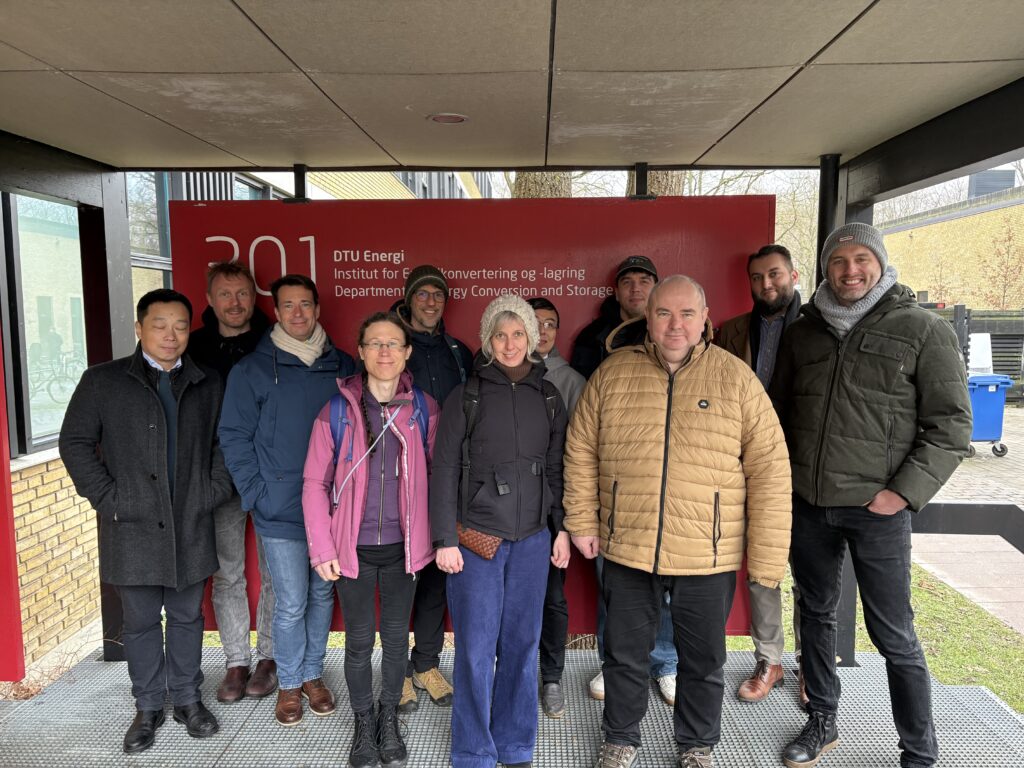
On 21st January, a kick-off meeting for the project CHARGE took place in Lyngby (DK), hosted by Technical University of Denmark.
The project started officialy on 1st December 2025 and will last for 36 months. The project is funded under the Clean Energy Transition Partnership (CETP) Joint Call 2024, within the call module Hydrogen & Renewable Fuels. CETP supports transnational research and innovation projects that accelerate the clean energy transition in Europe by bridging fundamental research, applied development, and industrial deployment, with a strong focus on impact, scalability, and alignment with European climate and energy objectives.
Project executive summary
The CHARGE project (Cost-effective green hydrogen using AC:DC operated durable SOECs) is a European research and innovation initiative targeting a major bottleneck in the clean energy transition: the cost, durability, and industrial readiness of solid oxide electrolysis cell (SOEC) technology for green hydrogen production. CHARGE develops a new generation of SOEC stacks that combine high efficiency, extended lifetime, and substantially reduced cost, enabling competitive hydrogen production below 5 €/kg and advancing the technology to TRL 5–6.
The project addresses key degradation mechanisms in SOECs by integrating impurity-tolerant cells, low-cost coated steel interconnects, advanced impurity mitigation strategies, and an innovative AC:DC operating mode that stabilizes performance under dynamic conditions typical of renewable electricity supply. By tackling materials, stack design, and operation strategies together, CHARGE provides a system-level solution with direct relevance for industrial deployment and Power-to-X applications.
Consortium and Partner Roles
- DynElectro (Denmark) – Project Coordinator
Leads overall project management and system-level validation. DynElectro pioneers and validates the patented AC:DC operation strategy on industrial-scale SOEC stacks and performs techno-economic analyses targeting LCOH reduction. - Technical University of Denmark (DTU, Denmark)
Develops and upscales high-performance, impurity-tolerant SOEC cells. DTU focuses on electrode microstructure optimization, electrocatalyst and impurity-getter integration, and long-term electrochemical durability under high current densities. - Gdańsk University of Technology (GUT, Poland)
Leads research on high-temperature corrosion, low-cost interconnect materials, and impurity emissions from balance-of-plant components. GUT also coordinates dissemination and exploitation activities within the project. - COAT-IT (Poland)
Develops scalable electrodeposition processes for advanced Mn-Fe-Cu spinel protective coatings on low-cost stainless-steel interconnects, enabling major cost reductions while maintaining long-term stability. - Forschungszentrum Jülich (FZJ, Germany)
Integrates advanced cells and coated interconnects into experimental SOEC stacks, providing rigorous validation in stack-relevant environments and detailed post-test analyses. - VERMES SOC Technology (Germany)
Manufactures and tests industrial-scale SOEC stacks, bridging research results to commercial products and supporting scale-up toward market-ready electrolyzer systems.
Together, the CHARGE consortium covers the full innovation chain—from advanced materials and cell design to industrial stack validation and system operation—creating a strong foundation for durable, cost-effective green hydrogen production in Europe.